

Piano Lessons
Benefits of Piano Lessons
The values of piano study have a wide range which include improving motor skills, attention, concentration, memory, and more! Piano study builds confidence, inspires creativity, teaches patience and self-discipline. Piano offers artistic expression that comes from the heart while also engaging the intellect. Playing the piano creates a rich musical environment in the home for the entire family.
Piano Lesson Age Requirement
The piano is a wonderful skill to develop at a young age. The best time to enroll in piano lessons is based on each students ability and maturity. A student may be ready for piano lessons when they:
-
Display an interest in music and a desire to learn how to play the piano
-
Have the ability to concentrate on a mentally challenging activity for at least 30 minutes
-
Have the ability to move three different fingers independently on three different keys
-
Develop hand size comfortable with stretching all five fingers across five white keys
-
Can recognize most numbers, recognize letters A-G, recognize patterns, and can learn new symbols and retain their meanings
Length of Piano Lessons
The ideal length of piano lessons for most students is 45-60 minutes because it provides sufficient time to integrate a wide variety of musical concepts. However, 30 minute lessons are offered for very young beginners, students with attention difficulties, or students with financial restraints. With special approval from the instructor, adults and advanced students may be offered a 60 minute lesson every other week.
Piano Lesson Structure
Below is an example of a 45-minute piano lesson for an intermediate piano student.
-
5 min: Choice of music notation, improvisation, auditory training, or composition
-
5 min: Scale and chord exercises
-
15 min: Review previous materials and provide assistance
-
15 min: Review new materials, concepts, and skills
-
5 min: Theory review or flashcard practice
Piano Lesson Materials
Students are responsible for purchasing their own materials. Upon registration, the instructor will provide specific materials to purchase depending on the student’s age, abilities, and unique needs. Most students can expect to invest around $100 on start-up materials.
Piano Lesson Curriculum
Piano students will utilize Faber Piano Adventures lesson books. This well-designed series uses a wholistic approach to encourage creativity, expression, and music analysis as well as develop fundamental skills like music literacy, ear-training, sightreading, improvisation, music theory, and more. This series also provides an extensive variety of supplemental materials.
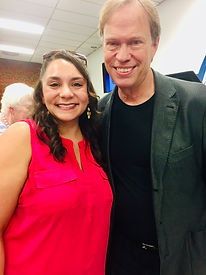
Noel meeting the renown composer, Randall Faber, at a piano teacher seminar in Columbus, Ohio. Randall Faber and his wife Nancy Faber have authored over 300 books, including the highly respected Piano Adventures method.
Piano for Home Practice
Piano students must have an instrument available for home practice.
-
Acoustic Piano: The ideal piano for home practice. An acoustic piano has rich sounds and authentic touch that is impossible to replicate. Certain skills can only be developed on an acoustic piano, like arm weight, finger weight, dynamic contrast, articulations, and more. An acoustic piano should be tuned 1-2 times per year and will begin to hold pitch better between regular tunings. Can be very affordable, as there are often gently-used acoustic pianos being offered for free
-
Digital Piano: Can be considered for home practice. A digital piano is always tuned and has a variety of fun digital features. However, even the best digital pianos will fail to accurately replicate the sound and touch of an acoustic piano. Ideally a digital piano will be full size, have weighted keys, provide touch sensitivity, and have at least 2 functioning pedals.
-
Keyboard: Can work temporarily but should not be a permanent solution. Understand that students may have to re-learn certain skills that will be impossible to practice on a keyboard. Ideally your keyboard will be full size, have a stand, and include a pedal attachment. Click here for information on keyboard rentals.
Realistic Expectations for Piano Lessons
Beginning students may take 2-3 years to fully grasp fundamentals, around 4-6 years to reach an intermediate level, around 10-12 years to reach an advanced amateur level, and 15-20 years to become a master professional pianist.
An advanced amateur could potentially earn income with their piano skills by accompanying vocalist or choirs, teaching basic piano lessons, providing background music for events, providing worship music for churches, etc. If desired, the advanced amateur could continue to study at the collegiate level.
Professional pianists have typically studied privately for 10-15 years before studying at the collegiate level for an additional 4-6 years, where they may be required to practice intensely for 2-5 hours daily. The professional pianist is a master musician. A professional piano career can include performing as a soloist, assisting professional orchestras and bands, being hired for celebrity recording projects like pop artists or hit movies, composing, directing, teaching at a collegiate level, and more!
Click here for tips on practicing the piano at home
Click here to read about educational curriculums vs. pop music